
My Headhunting Experience
Preface
Few outsiders can claim to have witnessed the start of a headhunting raid. This was my own experience over the course of a single day in April 1970. What follows is taken from the journal I kept at the time, which I only recently reread, 56 years later.
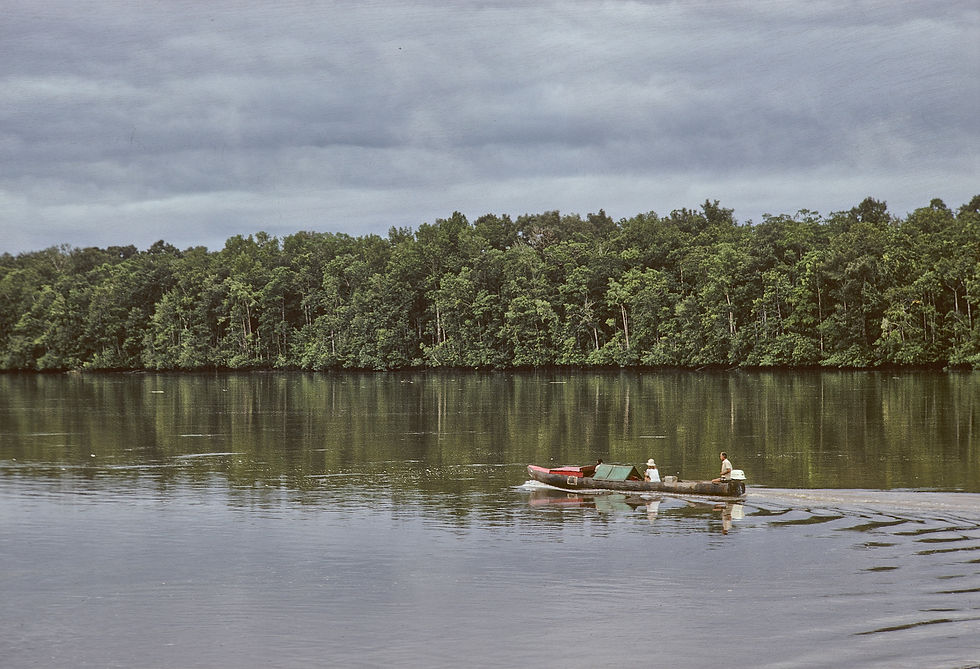
I was leading an expedition, sponsored by National Geographic, to the Asmat region of West Papua, the Indonesian-controlled western half of the island of New Guinea. Accompanying me were my first wife, Barbara, Clemens (Bert) Voorhoeve, a Dutch linguist who had studied the languages here back in the early 1960s, and a local guide, Andreas. We travelled from village to village in a canoe outfitted with an outboard motor.
The Asmat region, on West Papua’s south coast, is a flat expanse of sweltering jungle and mangrove swamp intersected by numerous rivers that originate in the central mountains and snake their way out to the Arafura Sea. Mud permeates the forest floor and extends thigh-deep for a considerable distance beyond the shoreline at low tide. This is where Michael Rockefeller disappeared without trace, in 1961.
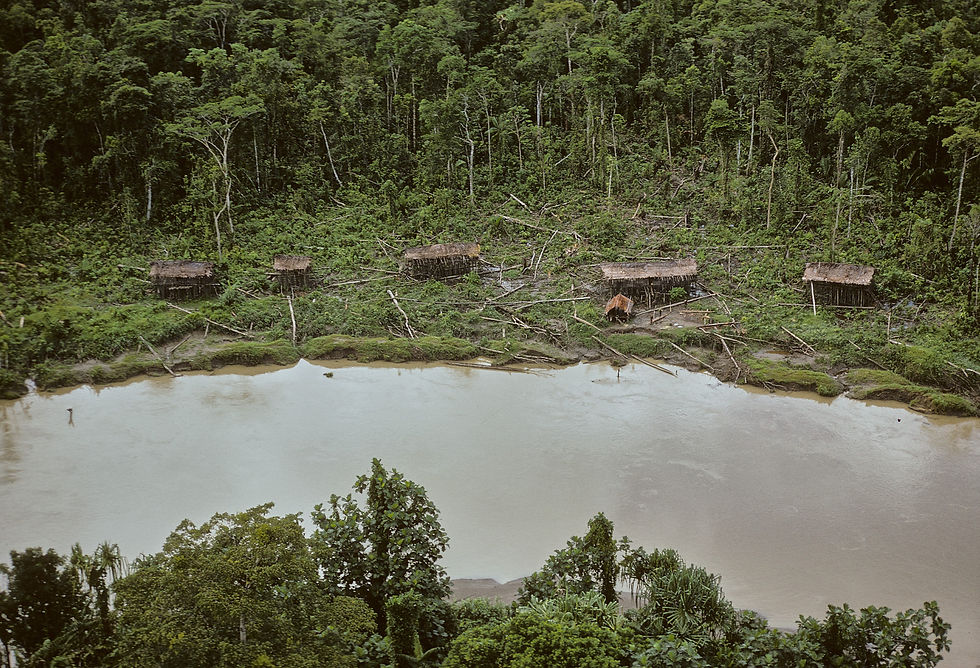
The people here practice headhunting, and occupy small settlements strung out along the river banks, their huts elevated on wooden stilts to protect them from flooding and potential attack.
Their headhunting tradition is linked to an affinity with the sago tree - their primary food source - and to its perceived resemblance to the human body. The legs correspond to the tree's roots, the torso to its trunk, and the arms to its branches, while the head is analogous to the germinating fruit, symbolising the continuity of life.
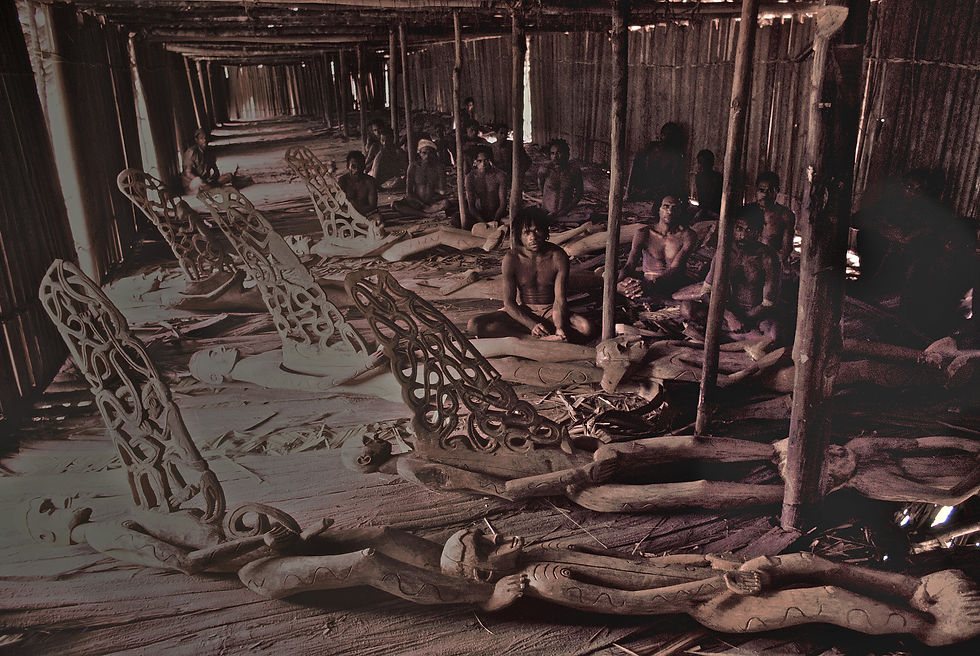
Each village has its ceremonial bachelors’ house, or jeu, where seated boys periodically undergo initiation into manhood, clasping freshly severed heads between their thighs in their transition to sexual maturity. After undergoing a ritual death and rebirth by submersion in the ocean, they subsequently assume the names and physical attributes of the victims and are even recognised as reincarnations of those individuals by the victims’ own relatives.
Friday, April 17th, 1970
After overnighting as guests of Father Jerry at the Catholic Mission in Komor, we set off at 7 a.m. up the Undir River, fighting against its swift current. We were heading into the interior of the Asmat - an area the government has little control over, and the local people know it. Consequently, they feel relatively free to carry on with their traditional headhunting practices.
Before leaving, the Father had warned us that five people - three men and two women - from Sagapo, one of the villages we were bound for upriver, had recently set off for a pig feast at Ti, the next village beyond it. They never returned. Their hosts had ambushed and eaten them. Andreas, our guide, looked uneasy, saying he was reluctant to go to Ti without the protection of a gun. We didn’t have one.
After two and a quarter hours, we passed by Manu village, noting that the place looked strangely deserted, and continued on to Tjemor (pronounced Tomor), which we reached one and a half hours later. Other than half a dozen naked men, some with grossly swollen scrotums indicative of elephantiasis, and a woman with a racking cough, it too looked almost deserted. While we stopped to make coffee, a man named Ndep arrived by canoe. He announced that he was the kepala (government-appointed chief) of Tjemor, and asked to accompany us to Ti. Since he claimed to speak the local dialect, we agreed.
Before departing Tjemor, we inspected a couple of the jeu there. Tjemor is actually a conglomeration of 3 villages, each with its own jeu, though on the map they appear under the single heading of Tjemor - a naming shortcut that applies to several other Asmat villages as well.
The jeu stood about 10 feet above ground, supported on slender poles that created a cage-like space beneath. Entry was via a steeply sloping notched log. The pole floor, covered with bark, had three entrances facing the river. Inside were two rows of fireplaces, about five against each of the two long walls – unusual for the Asmat, where a single row is more typical. Bows and arrows and pigs’ jaws hung suspended above the hearths.
We left Tjemor with Ndep seated in the prow and reached Sagapo in an hour, much sooner than we had anticipated. The men in Tjemor had tried to dissuade us from going, saying that Sagapo lay a great distance away - a claim they demonstrated by raising one arm in the direction of the village and slapping the armpit with the cupped hand of the other.
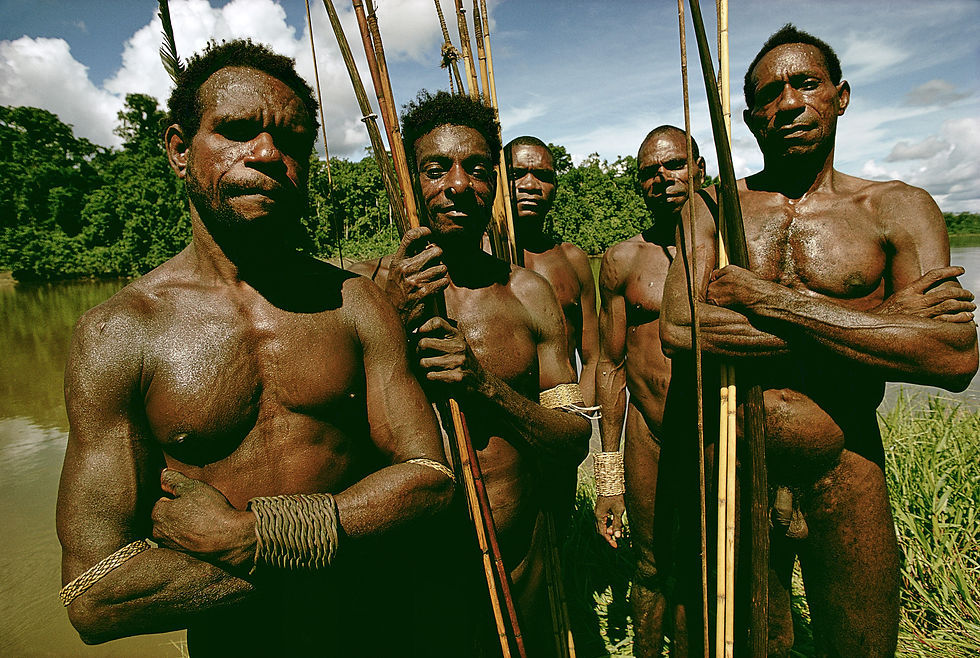
Sagapo consisted of about 4 houses situated on a high, grassy bank to our left. As we disembarked, we were met by a group of naked men, several of whom had just preceded us in freshly painted canoes with carved prow ornamentations. Most wore cane wristguards, a protection against the backlash of bowstrings. They looked intimidating, and did not seem pleased to see us.
“Is this Sagapo?” I asked, puzzled.
Following an unintelligible discussion amongst themselves, they finally said yes, it was Sagapo.
“Then who are we talking to?”
“We are from Manu.”
“Where, then, are the Sagapo people?”
“Away in the bush,” came the reply, with a gesture towards the surrounding jungle.
Gradually, I began to sense trouble brewing. Had the Sagapo people fled in fear, or had something worse already occurred here? Either this Manu party had come to help Sagapo avenge the killings by Ti, or - since no one from Sagapo was present - they had already raided the village themselves, and were preparing to continue to Ti.
I was curious to inspect the interior of the jeu, a bark-sided structure, which I reached by crossing a log that spanned a shallow ravine. Bows and arrows were stacked above a row of fireplaces along the rear wall, decorated with crude charcoal drawings.
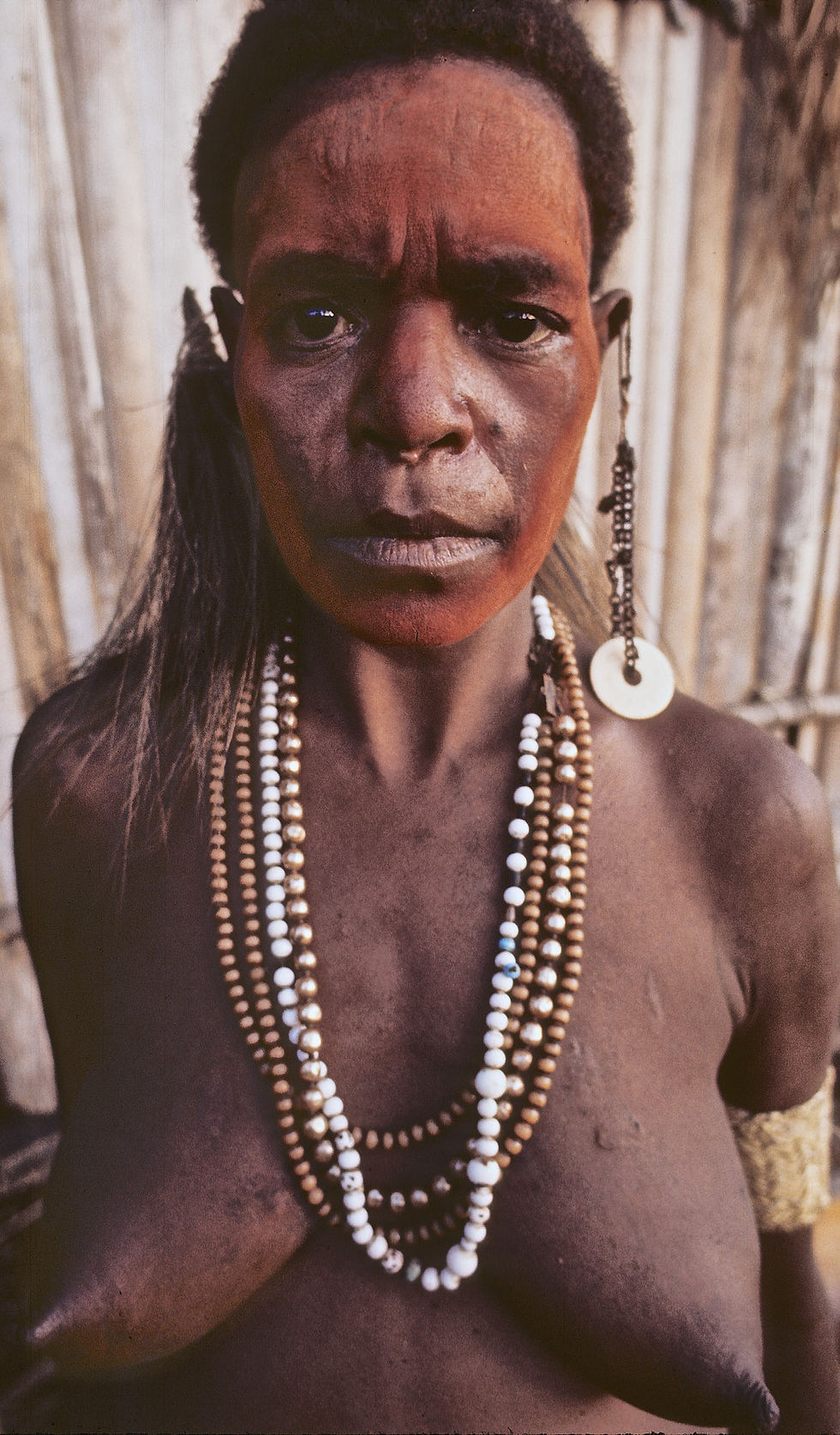
Before we set off again, I took a few portraits of the group’s most formidable-looking warriors, motioning them to pose with their weapons. One of them called out, and a woman emerged from a house near the jeu, holding their bows and arrows. Her face was daubed in red ochre, the significance of which momentarily eluded me, until I recalled that women accompanying a headhunting raid typically decorate themselves in this manner.
By the time we climbed back down to our canoe, watched closely by the whole party, Andreas and Ndep had become visibly nervous. Bert, too, looked apprehensive.
The current above Sagapo grew swifter, and we fought to avoid capsizing on submerged sandbanks and tangled roots. Bert and Andreas began making excuses - too many obstacles, the current was too fast, the people at Ti would only run at the sight of us anyway, so why go on, time was running out, we ought to turn back for Tjemor. However, with some encouragement, Bert continued steering the canoe between the snags and floating logs.
Progress was agonisingly slow. We passed a couple of recently abandoned canoes, then a hut, partially concealed in the jungle bordering the riverbank - with smoke still curling up through its roof. There was no sign of life, but we waved a greeting, knowing that we were being observed. Each bend in the river took longer to round than the last, and the afternoon was drawing to a close.
Finally, rounding one more bend, there they were - three grey-brown huts in the elbow of the river, positioned with a view of both approaches. Our sudden appearance set off a flurry of activity - we could see figures running in and out of the houses, before vanishing into the bush with their weapons and whatever else they could carry.
By the time we touched the bank at 3.30 p.m., the settlement stood eerily quiet.
Ndep began shouting into the jungle. He had claimed to have some kind of relationship with these people, but there was no response. He kept calling. The tuans (foreigners), he told them, had brought tobacco to trade.
Without any warning, a wiry figure, his hair braided with brown fibres, dashed out of the bush carrying a pole with a limp, ragged Indonesian flag fastened to one end. In a scene reminiscent of raising the flag at Iwo Jima, he struggled to plant it in the mud, where it eventually stood, leaning at a sharp diagonal.
He then ran back beneath one of the houses, where we watched him put on a grimy old shirt that had more holes in it than substance.
Ndep continued calling out. Eventually a pregnant woman and an elderly man emerged tentatively from the house to our right. I waved a greeting.
The woman descended a notched pole some 15 feet to the ground, joined there by another man, his hair also braided with fibres. Together they approached Ndep, smiling nervously, and began talking - they appeared to be related somehow.
Then a fourth man arrived. Like the others, he was naked, but he wore an olive-drab peaked cap like ours. Someone said he was the kepala. A fifth man followed, his scrotum covered in pink sores, then a shy, young girl.
Encouraged by Ndep, though clearly unsure of the gesture’s intent, they shook hands with us.
The kepala was extremely nervous and suspicious, keeping his distance and monitoring our every move as he tried to comprehend why we had come here.
Bert began taking a word list while I slowly returned to the canoe to collect the case with my Polaroid camera. Any sudden motion caused the atmosphere to grow tenser. Everyone kept glancing nervously over their shoulders.
I beckoned Ndep’s male acquaintance forward. Ndep instructed him to face the camera, but confronted by the lens he immediately looked away and stared down at the ground. I took the picture and waited a minute for it to develop before handing it to him. I watched his face closely for a reaction, but he gave none.
I motioned the kepala to come closer, but he retreated behind the house in the centre. After some persuasion, I got a picture of him too, but other than giving it a wary glance, he likewise expressed no emotion.
I passed the camera over to Barbara while I went back to the canoe for our box of trade items. By the time I returned, she had already photographed the shy young girl, who was surprisingly well decorated. She appeared to recognise herself, then quickly rubbed the skin between her breasts with her fingers and smeared grease over the image, attempting to counteract what she perceived to be sorcery.
However, once everyone understood that we wished to trade, they responded eagerly. Very shortly I had exchanged a knife, tobacco, and fishhooks for a shield, a bamboo horn, and some sago. Salt would have been more appropriate - we later learned that they grew their own tobacco.
Having established a tenuous relationship, we gained permission to enter the jeu in the centre. Andreas wandered off somewhere with the kepala, while we awkwardly surmounted the notched pole and entered the structure. There were several still-smoking fireplaces against the back wall, an armoury of bows and arrows stacked above them, clusters of pigs' jaws fastened to the pole supports surrounding the hearths, and, on the racks above, piles of bones, along with what initially appeared to be the crowns of human skulls. Upon closer inspection, I was relieved to discover they were actually turtle shells.
Daylight was fading. The tension of the afternoon had distracted me from taking many pictures. But as soon as I began photographing the jeu’s interior the men grew agitated and moved towards the exit, ready to flee. Bert was anxious to leave too.
Andreas, who had earlier disappeared with the kepala, now returned to inform us that he had seen fifteen men encircling our jungle clearing, bows drawn, ready to attack, should I make any unexpected move with my cameras and tripod.
At 4.40 p.m., with Bert calling out half anxiously and half in irritation, we packed up our equipment, climbed back into our canoe, and set off downstream. Before we parted, Ndep warned them about the Manu raiding party making its way upstream.
The kepala and his men looked relieved to see us go, glad that we had caused no trouble. As Ti receded behind us, they gathered on the river bank and performed a little dance, accompanied by exuberant whoops.
It was twilight as we approached Sagapo at 5.50 p.m. In the dusk we could make out two canoe-loads of men pushing off to intercept us in midstream. Hoping to persuade us to stop, they held up items to barter. My inclination was to pause and attempt to talk them out of proceeding upriver, but Ndep, clearly afraid of their intentions, stood up in the prow and urged Bert to keep going. In response, Bert accelerated and we swerved around them. Once safely past, Ndep called back to the surprised men that Ti was deserted, then muttered that they intended to rob us.
We continued on to Tjemor in near darkness, the river dimly lit by a half moon. Arriving at 6.30 p.m., we were greeted by a throng of men clamouring for tobacco, which they seemed strongly addicted to.
To our surprise, we found a second band of Manu warriors assembled here too, all wearing the familiar cane wristguards. They appeared to be on friendly terms with the Tjemor people. Together they killed a pig and celebrated with drumming and singing in another jeu at the far end of the village. We, meanwhile, had a fitful night’s sleep.
By dawn the group had departed, paddling upstream to join the others at Sagapo.
What happened next, we will never know.







Comments